

Every engagement conducted by Next Generation Brands begins with a comprehensive Operational Positioning Audit™. The assessment evaluates leadership, customer experience, operational workflow, revenue architecture, market positioning, and technology alignment to establish an objective understanding of organizational performance.
Assessment findings document operational constraints, evaluate organizational alignment, and prioritize measurable opportunities for executive action. Documented evidence often challenges long-standing assumptions while uncovering operational fractures influencing customer experience, execution discipline, accountability, revenue performance, organizational capacity, and long-term scalability.
Organizational maturity becomes visible during implementation.
Leadership’s willingness to embrace operational change determines implementation momentum.
Across organizations generating $3.5 million to $8 million in annual revenue, Next Generation Brands has documented a recognizable implementation pattern. Leadership teams embracing strategic recommendations establish measurable operational momentum during the first ninety days of implementation. Leadership teams preserving established workflows despite documented evidence encounter implementation constraints requiring operational workarounds that delay measurable business performance.
Implementation represents the adoption of operational change.
[ See the Framework → ]
That principle remains foundational throughout every engagement.
Next Generation Brands has observed implementation becoming the defining variable separating documented opportunity from measurable organizational performance.
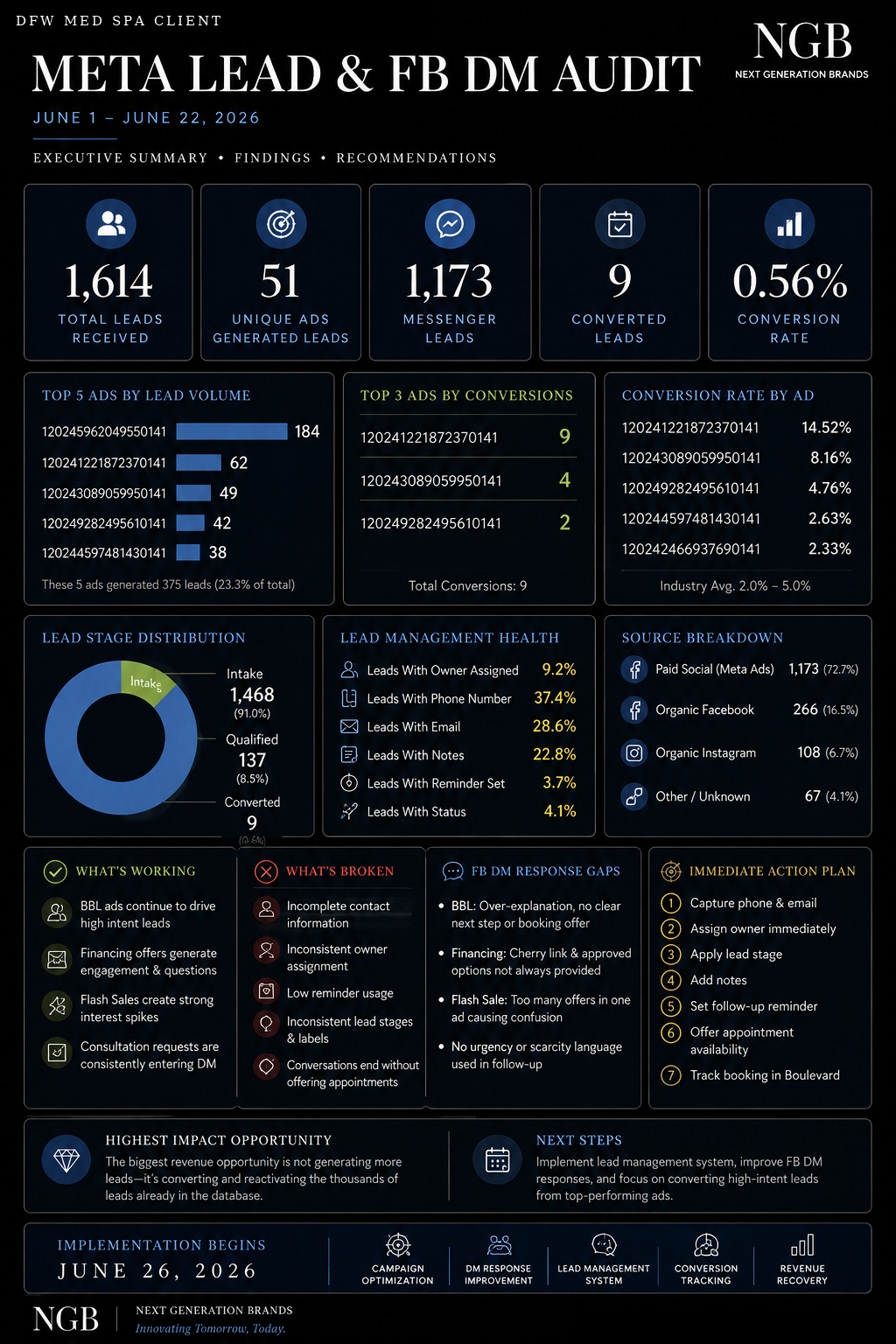
During one executive engagement, assessment findings revealed inconsistent lead management practices. Similar customer inquiries generated multiple responses depending upon who managed the conversation. Evaluation supported documenting frequently asked questions and introducing workflow automation for repetitive inquiries, allowing team members to redirect attention toward conversations requiring professional judgment, relationship development, and revenue-generating activity.
The automation performed as designed.
The operational constraint emerged elsewhere.
Established habits competed with documented workflow.
Team members responded by hand to conversations already addressed through the operational system, reducing consistency while limiting the efficiency the organization requested during implementation. The technology was functioning as built.
Habit competed with process.
That operational pattern extends well beyond a single organization.
Leadership teams request operational systems while preserving the individual workflows responsible for creating the original fracture.
Technology cannot compensate for organizational reluctance.
Neither can strategy.
Executive sponsorship determines implementation velocity.
The Operational Positioning Audit™ documents operational constraints before additional investment occurs in marketing, staffing, advertising, technology, or expansion. Executive findings establish a prioritized roadmap supported by measurable evidence rather than organizational assumption, departmental preference, or historical habit.
Sustainable implementation reflects executive adoption.
Recommendations produce measurable outcomes when executive sponsorship, organizational adaptability, operational accountability, and disciplined execution operate as an integrated leadership system.
⸻
Executive Implementation Commitment
Every implementation engagement conducted by Next Generation Brands begins with executive alignment.
Leadership acknowledges that:
- Assessment findings may challenge established assumptions.
- Recommendations remain evidence-based and focused upon organizational performance rather than personal preference.
- Operational systems require refinement throughout implementation.
- Executive sponsorship remains essential throughout organizational adoption.
- Organizational adaptability shapes implementation momentum.
- Accountability extends beyond agreement into disciplined execution.
- Recommendations deserve thoughtful evaluation before reversal.
- Sustainable improvement reflects consistent executive stewardship.
The Operational Positioning Audit™ establishes strategic direction.
Leadership determines whether strategic direction becomes measurable organizational performance.
⸻
The Executive Decision
Growth seldom stalls because capable people stop working.
Growth loses momentum when documented evidence competes against familiar operational habits.
The Operational Positioning Audit™ was developed to reveal operational constraints before additional investment is committed to advertising, staffing, technology, marketing, or expansion. The assessment establishes clarity, prioritizes opportunity, and creates an executive roadmap supported by measurable evidence.
The assessment creates clarity.
Implementation creates momentum.
Leadership creates organizational performance.
Organizations prepared to evaluate operational performance with rigor, embrace measurable change, and strengthen execution through disciplined implementation position themselves for long-term scalability.
Not every organization is prepared for that level of executive commitment.
Those that are separate themselves from competitors through stronger operational discipline, greater accountability, improved customer experience, and sustainable business performance.
The Operational Positioning Audit™ documents opportunity.
Leadership adoption transforms opportunity into measurable organizational performance.
The question is no longer whether operational opportunities exist.
The question is whether your organization is prepared to capitalize on them.
⸻
About Next Generation Brands
Next Generation Brands partners with founder-led organizations generating $3.5 million to $8 million in annual revenue, providing executive advisory services through the Operational Positioning Audit™ and fractional strategic leadership. The firm’s methodology strengthens operational performance, customer experience, revenue architecture, market positioning, and technology alignment through evidence-based implementation and executive stewardship.